How we run a fully remote agency and still deliver for international clients
Fully remote since 2017, Concealed delivers projects for clients across three continents from a Lisbon-based team — staying predictable through daily written updates, not sporadic check-ins.
- Business

Since Concealed was created in 2017, we've heard the same story from new clients about previous providers: weeks of silence between updates, deadlines that slipped without warning, and a final product that didn't match what was scoped. Many of those providers were remote too, so when we told clients we're remote as well, a Lisbon-based team working across projects, it wasn't the reassurance they expected to hear. It only became real once the first few weeks played out the way we said they would, with daily updates and nothing to chase us for. The shift in how these clients experienced a remote collaboration is real, and it's the reason I decided to write this post and explain how we do it.
Being remote isn't the risk. Being unpredictable is
Most of the bad experiences people describe with remote providers aren't really about distance. They're about a team that never built the discipline to keep the client informed at all times. Concealed has been remote and async since day one. That's not a policy we adopted after a client complained, it's the whole operating model, which means we've had years to build the muscle instead of bolting it on after something broke.
Always in the loop, wherever you are
Every team member logs a daily project update, so clients always know where things stand without scheduling a call to find out. Internally, that comes from a daily stand-up and wrap-up: each morning, a person states what they expect to finish, and by end of day, they report what actually got done. The gap between the two is usually the first sign something's blocked, whether that's a client sitting on feedback that was due, or a sprint running short on ready work, and it's what lets me, as the team's COO, step in early instead of after the problem reaches a client's inbox.
Once scope and deadlines are agreed, we hold to them the same way. If we're moving faster or slower than what we promised, that shows up in the same daily update, not as a surprise when the deadline arrives.
You talk to the people building it
Every team member at Concealed is fluent in English, and everyone communicates directly with clients in the project's own channels and calls. There's no account manager relaying messages between you and the people actually doing the work, and no admin layer added just to look more formal. Every project starts the same way: a kickoff call with the team and the client, to get to know each other and agree on goals and next steps before anything gets built.
We also default to a call whenever a conversation actually needs one. Long back-and-forth threads waste everyone's time when five minutes on a call would settle it, so we don't let a decision drag out in writing just because that's how it started. Day to day, we prioritize instant communication in Slack/Teams/Discord (whichever the client already uses), over email, unless something needs to exist in writing for legal or management reasons.
Meetings happen in the best slot for everyone
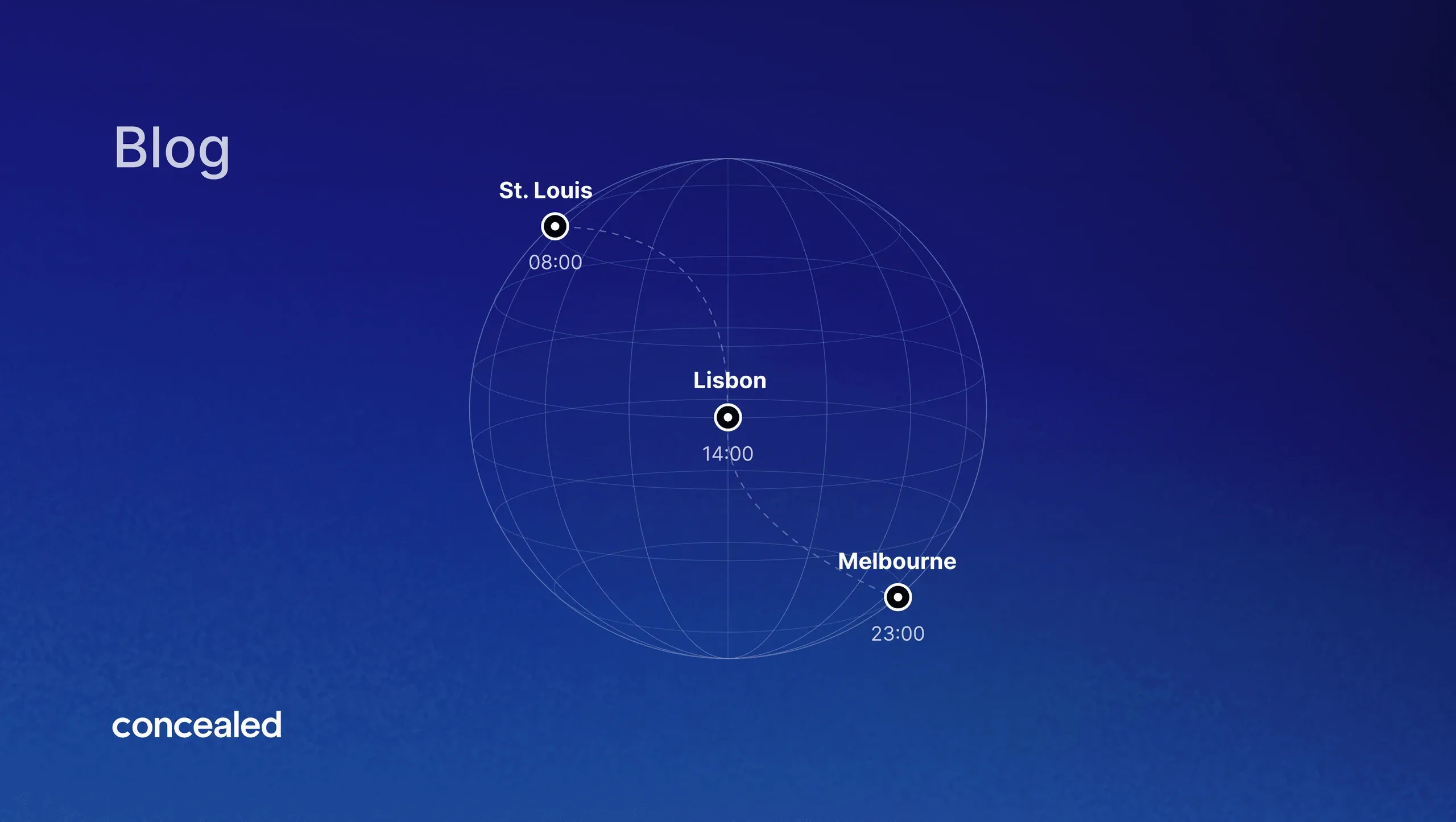
On any given week, we're coordinating with Maritz in St. Louis, Missouri, Gleam in Melbourne, Australia, and simMarket in Germany, on top of the rest of our project load throughout the globe. St. Louis, Lisbon, Melbourne and Germany don't share a comfortable working hour by default at all. So instead of picking one time zone and asking everyone else to adjust, we find whatever overlap exists inside everyone's normal working hours for each specific conversation, ours and the client's, and build the meeting there. If we book meetings in advance, everyone can fit it into their regular schedule, even if on opposite sides of the world.
That spread also reflects the range of work we do for each of them. Gleam's marketing website was rebuilt in Framer, the same tool we use for most client sites. Maritz's XPress Leads platform is an ongoing design engagement that's run since 2024. simMarket's desktop app is custom software we built from scratch in 2020 and still actively maintain. Different countries, different time zones, different types of work, same discipline underneath all of it.
We also protect the meetings we do keep just as deliberately. Client presentations used to run Friday afternoons until we noticed how much it drained the team, and it showed in the work by Monday, with no relevant benefit. We moved them to the beginning of the week: this way, if something needs tending to, we're already working on it instead of interrupting everyone's time off on the weekend.
We never go dark
No active client goes more than 24 hours without hearing from us. Leads and past clients hear back within two days, at the latest. We also don't ask clients to adopt our tools: we work inside whatever platform they already use, Slack, Microsoft Teams, or Discord, so an update from us never means opening one more inbox.
The proof is in who continues to work with us
We have 11 five-star reviews on Clutch. Most clients start with one project and end up commissioning more, some for over 8 years, out of the 30+ companies we've worked with since founding. Referrals keep arriving from people we worked with years ago. That's the actual return on treating "remote" as an operating discipline instead of an excuse.
The part that's genuinely harder
Remote agency work has a real failure mode. With the team spread across different projects, each person can end up working in relative isolation, closer to freelancing than to being part of a company, without anyone nearby to think out loud with. We built two things directly against that, and neither is client-facing: a daily department sync, cameras on, design and dev separately, where blockers and learnings actually get shared instead of solved alone. I also instituted a weekly whole-company meeting for what doesn't fit inside a project update: company announcements, the coolest thing everyone shipped that week, and what we learned from it. It's not just information sharing. It's the reminder that we're not ten freelancers who happen to invoice from the same page.
It also means that when you hire Concealed, you're hiring the expertise of the whole team, not just whoever happens to be on the call. Those daily syncs and shared challenges are what make that true in practice, not just a line in a pitch.
Being remote was never the risk. Being disorganized about it is. We built the discipline before it was fashionable, because we never had an office to fall back on, and it's the reason clients on three continents can trust a project's status without needing to ask for one.
If you're evaluating whether a remote team can actually deliver, see what our clients say or let's talk about your project.
Frequently Asked Questions
Can a fully remote agency deliver the same quality as an in-office team?
Yes, if the team builds real communication discipline around it: daily documented updates, clear ownership per task, and response-time commitments. Concealed has operated fully remote since day one and adapts meeting schedules to the client's time zone, not the other way around.
How does Concealed handle time zone differences with international clients?
We don't set a fixed meeting time and ask clients to adapt to it. Right now that means finding overlapping working hours with clients in St. Louis, Melbourne, and Germany, on top of the rest of our project load, and every team member posts daily project updates so no one has to wait for a scheduled call to know where things stand.
How fast does Concealed respond to client messages?
Active clients never go more than 24 hours without a reply. Leads and past clients hear back within two days. We communicate on whatever platform each client already uses.
What tools does Concealed use to communicate with clients?
We integrate into the client's existing communication platform, Slack, Microsoft Teams, or Discord, rather than asking clients to adopt new tools. Project details live in Linear and get mirrored into the client's own channel.
Does everyone on the team communicate directly with clients?
Yes. There is no account manager or admin layer relaying messages. Every team member is fluent in English and works directly in the client's project channels and calls, and every project starts with a kickoff call between the full team and the client to agree on goals and next steps.
Does a remote setup create any real downsides?
Yes. Team members can end up working in relative isolation across separate projects, which without deliberate structure starts to feel like freelancing rather than teamwork. We address it with daily department syncs and a weekly whole-company meeting focused on connection, not just status.
Written by Catarina Coimbra, COO at Concealed, a Framer Expert agency based in Lisbon building fast, scalable websites and custom internal tools for companies.